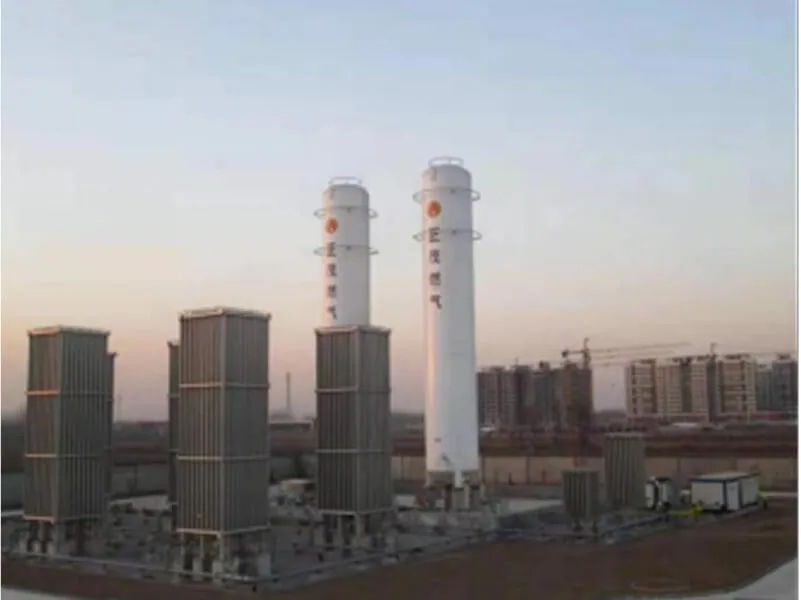
Ambient air vaporizer frost is the one thing every buyer of these units eventually asks about. The unit is cheap to run because the air does the heating, and the same air is what coats the tubes in white. This note explains why frost forms, what it does to output, and the ways plants normally live with it. It also says where frost stops being a nuisance and becomes a reason to choose a different heat source.
How an ambient air vaporizer works
Our air ambient vaporizer has three main parts: a pressure regulating cabinet, a heat exchanger, and a liquid level indication and protection system. A cryogenic liquid such as LNG, LOX, LIN or LAR flows inside the tubes and absorbs heat from the surrounding air by natural convection. Nothing else supplies energy. No electricity, no steam, no fuel.
Protection is built in. The unit has dual pressure protection, with an inlet regulator installed in series, an integrated safety relief system against overpressure, and a shut-off device with optional remote monitoring. Design pressure is 1.6 MPa.
That's the appeal. The heat exchanger is made of low-temperature aluminum alloy, there are no electric heating elements or open flame, and the unit can stand outdoors. The published LPG range is 50 to 1000 kg/h, and for other gases it's 100 to 10,000 Nm³/h.
The patent literature on cryogenic regasification describes the typical unit the same way: vertically positioned tubes whose exteriors are exposed to the atmosphere and carry an extended heat transfer surface. Finned aluminum is common. The fins give the air more surface to work with, and, as we'll see, more surface for frost to settle on.
Why frost forms and why it hurts
Liquid at cryogenic temperature keeps the tube surface far colder than the air around it. Moisture in that air meets the cold metal and freezes there. The result is frost on the finned tubes, and the same patent background states plainly that frost forming on the surface of the finned tubes leads to capacity degradation over time.
It helps to picture what the frost does. It's a layer sitting between the cold tube and the warm air, and heat has to cross it. The thicker it gets, the less heat arrives, and the less liquid the unit can turn into gas. When the vaporizer is asked for the same flow it delivered on day one, the outlet gas comes out colder.
Two site conditions make this worse. A humid atmosphere brings more moisture to freeze. And a cold atmosphere leaves less temperature difference to drive heat in. A mild, dry site may see little trouble; a damp, cool one will see plenty.
The usual answer: two banks, taking turns
Because the fix is to melt the frost, the standard layout gives the plant more than one set of units. The patent literature describes systems configured with two banks of ambient units that operate alternately: while the first bank runs, the second is off or idle so it can defrost. A control valve on each line decides which bank receives liquid, and the two lines rejoin downstream.
It works, with limits. The same source points out that an idle bank may not finish defrosting before it's called back into duty, particularly in cold or dry conditions, so capacity is never fully restored and both banks can slide downward together. Frost can also turn from soft rime into hard ice that bridges the fins, and removing ice takes longer than removing frost. Simply lengthening the cycle isn't a cure either, because a longer cycle needs more heat transfer area, which means more units for the same output.
The opposite problem exists too. In warm, humid weather the idle bank may be fully defrosted long before it's needed, and that spare capacity sits unused.
Trim heaters, forced hot air and other helpers
When the ambient units can't bring the gas up to the temperature the downstream pipe needs, plants add heat at the outlet. The patent background describes an optional trim heater downstream of the banks, powered by electricity or natural gas, used in cold weather to superheat the vapor further. It's one more piece of equipment, so it belongs in the cost comparison from the start.
Our ambient unit has a related option: a forced hot air system, available for colder climates or high-demand conditions. We don't publish a capacity uplift for it, so treat it as a conversation to have with an engineer, not a number to plan around.
On the LNG side, our regasification equipment uses a patented finned tube design. The stated aim of the fin structure is to increase heat exchange area and to get past the efficiency fade that frosting causes in a traditional vaporizer. If you're evaluating LNG duty, see the LNG vaporization line.
Site habits that keep frost manageable
Some of the cure is physical. Our installation guidance calls for a well-ventilated area and a mounting height of at least 200 mm above ground level. Air movement is what brings the heat in, so anything that blocks it works against you.
Other habits are operational, and these are our reading of the patent discussion rather than a rule. Let the idle bank rest long enough to finish defrosting, and judge the cycle by how fully it recovers, not by the clock. And keep an eye on outlet gas temperature trends, since a bank that no longer recovers will show it there.
Questions to ask before you buy
Frost behavior is a site question, so put these to any supplier of ambient units, including us:
- What ambient temperature and humidity is the sizing based on, in winter as well as summer?
- Is the duty continuous, or a back-up and peak-shaving service? A patent source separates continuous supply systems from back-up systems, and the defrost burden differs between them.
- How many banks are proposed, and how does the changeover work?
- What is the lowest gas temperature the downstream pipe can take? The pipe to the user is typically carbon steel, which can turn brittle at low temperature.
- Is a trim heater included in the price?
When frost says choose another heat source
Frost is a design input, not a defect. If your site is cold and humid, if demand is continuous and high, or if you can't afford a bank sitting idle, an ambient system gets expensive in area and units. At that point a heated alternative is the sensible comparison.
An electric water bath vaporizer doesn't depend on the air: its performance isn't affected by low ambient temperature, and it carries an integrated gas-liquid separator and safety interlocks. Where steam exists on site, a steam-heated unit covers larger volumes. Our note on choosing the vaporizer heat source sets the three side by side.
To get a recommendation, send the gas type, flow, working pressure, lowest ambient temperature and humidity of the site through the contact page.
FAQ
Why does frost form on an ambient air vaporizer?
The tubes carry cryogenic liquid, so their surface is far colder than the surrounding air. Moisture in the air freezes on the cold fins and builds a layer that slows heat transfer.
How is an ambient air vaporizer defrosted?
A common arrangement uses two banks that work in turns. One runs while the other sits idle and defrosts. Cold or dry weather can leave an idle bank only partly defrosted, which is why cycle times and bank sizes are set for the site.
Can a trim heater help an ambient vaporizer?
Yes. A trim heater downstream of the banks can raise the outlet gas temperature in cold weather. It is powered externally, by electricity or natural gas, so it adds equipment and running cost.
When should I choose a water bath instead?
When winters are cold and humid, demand is continuous, or a bank cannot be spared for defrosting. A water bath unit's performance is not affected by low ambient temperature.