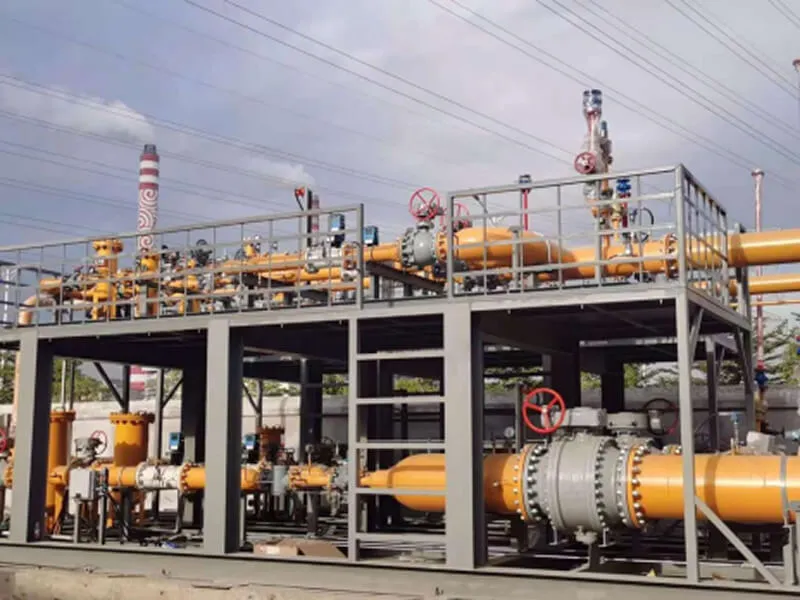
At a city gate station, gas leaves a high-pressure transmission pipeline and enters a city or industrial distribution network. Everything in it exists to make that handover safe, steady and measurable. This note follows the gas through the station in the order it meets each function, and uses the operating conditions of four projects we supplied to show how the same layout stretches from a residential estate to a very large city feed.
What the station is for
Transmission pipelines run at high pressure so gas can travel far. Distribution networks run much lower, partly because their pipes can't take transmission pressure. A public engineering explainer describes the gate station as the boundary between the transmission system and the local distribution company, and also the commercial point where ownership of the gas changes hands. That second role is why the station has to measure as carefully as it regulates.
Our natural gas pressure regulating and metering line covers the same ground. It's used for urban gas, industrial users, LNG receiving stations and gas-fired power. One Malaysian station ties a 66-inch high-pressure transmission pipeline to downstream city distribution and industrial connections.
Start from the pressure drop and the flow
The first design question is how far the pressure has to fall and how much gas has to pass. Four stations from our project list show the spread.
| Project | Flow, Nm³/h | Inlet pressure | Outlet pressure |
|---|---|---|---|
| Algeria, residential supply | 500 | 1 MPa | 0.2 to 0.4 MPa |
| Indonesia, city gas pipeline delivery | 150,000 | 4 MPa | 0.4 to 0.6 MPa |
| Malaysia, city gate and industrial users | 160,000 | 3.8 to 4.0 MPa | 0.45 to 0.8 MPa |
| Tanzania, city gate | 800,000 | 5 MPa | 2 MPa |
Flow decides how big every pipe, valve and meter must be. The pressure ratio decides the number of regulating stages, and how cold the gas gets. Write both down, with the minimum and maximum of each, before anything else.
Filtration comes first
Pipeline gas carries dust, moisture and other impurities, and regulators are the parts that suffer. In the Indonesian station a large-capacity filtration unit removes dust, water and other impurities so the regulators downstream aren't fouled and keep a long working life. Malaysia's skid opens with a filtration unit as well. For larger flows, a vertical filter separator is one of the options we build for outdoor metering and regulating stations.
Plan for maintenance here. In a coal mine gas skid we built, reusable filter elements and a bypass valve let the operator service the filter without interrupting supply. The same thinking applies at a gate station, where an unplanned stop affects every user downstream.
Staged regulation and redundancy
Big pressure drops are taken in steps. The explainer notes that engineers commonly reduce pressure in two or three cascading stages because it gives far better control over the steady outlet pressure than one large cut. Our Indonesian and Tanzanian stations both use multi-stage pressure regulation. In Tanzania, multiple parallel lines also keep gas flowing if one line is out of service.
The regulator arrangement matters as much as the stage count. Our pressure regulating system uses a main regulator plus a monitoring regulator in a dual-channel design, switching automatically on a fault so supply continues. Its published performance is an outlet pressure error below ±2%, and fluctuation below ±1% in a customized multi-stage version. Small stations can be simpler: the Algerian estate station uses a self-operated regulator with safety shut-off valves, relief valves and filtration, a mechanical design chosen to keep maintenance low where local technical resources are limited.
Keeping the gas warm enough
Gas cools as it expands through a regulator. That's the Joule-Thomson effect, and the larger the pressure drop the larger the temperature drop. A patent on gate station heating spells out the risk: large pressure reductions combined with often cold incoming gas can leave the gas below freezing after pressure reduction. Ice then damages mechanical parts or blocks flow.
The usual cure is to heat the gas before the regulators. The explainer describes indirect-fired line heaters placed immediately upstream of the pressure reduction equipment, with upstream and downstream temperatures monitored. For cold sites, our pressure regulating system can be matched with reheaters, cyclone separators and gas storage buffer tanks, depending on the gas components and the site. For very low temperatures such as -50 °C, the answer is a low-temperature valve with electric heating or a recuperator design.
Check the heating load early. A station with a large pressure ratio and a cold climate needs it sized into the utilities from day one, not added after commissioning.
Metering: where the money is counted
Downstream of regulation the gas is measured. The explainer says gate stations use highly accurate meters, turbine technology among them, and that precision matters because the measured energy is the basis for billing between the two companies. Our Tanzanian station uses a high-accuracy metering system with temperature and pressure compensation, and the Malaysian one adds flow computers for real-time monitoring and data management, which the project notes tie to accurate settlement. Our turbine flowmeter is built for this kind of duty.
Odorization and safety
Natural gas has no smell of its own, so an odorant goes in at or just after the station and leaks get noticed. In Indonesia one package covered filtration, regulation, metering and odorization.
Overpressure, underpressure and leakage are all monitored, and the emergency shut-off (ESD) reacts in 0.1 seconds. Shut-off valves, relief valves and pressure monitoring instruments guard the network downstream; for the shut-off device, see the pressure regulator and shut-off valve. Pressure and flow can also be watched remotely on a phone or computer, with SCADA docking supported.
Planning inputs that change the design
Three conditions in the project notes show how site facts reshape a station. Limited local technical staff in Tanzania meant a simple, modular design that's easy to maintain. High heat and harsh conditions there called for robust equipment, and the Algerian estate station was likewise specified for high heat and dust. Continuous 24 hour city supply, as in Indonesia, puts reliability above everything else, because any interruption reaches thousands of end users.
Skid or site-built?
Every station in the table is skid-mounted, so pipework, valves and instruments are assembled and tested at the factory before shipping. Less site construction and quicker commissioning are the reasons the notes give, and it also suits sites short of technical staff.
If you're planning a station, bring the gas composition, flow range, inlet and outlet pressure ranges, site temperature range, metering and odorization requirements, and applicable local standards to the contact page. That's enough for a first configuration.
FAQ
What does a city gate station do?
Gas is cleaned, stepped down in pressure, measured and, where required, odorized here before it enters the city system. The station sits between a high-pressure transmission pipeline and a distribution network.
Why is gas heated before pressure reduction?
Expansion through a regulator cools the gas, and a big pressure drop on cold incoming gas can take it below freezing. Ice then damages equipment or blocks flow, which is why the gas is heated upstream of the regulators.
How many pressure regulation stages does a city gate station need?
It depends on the pressure ratio. Engineers commonly use two or three stages for large reductions because control is better than with one big cut. Our Indonesian and Tanzanian stations use multi-stage regulation.
What is the difference between a city gate station and a pressure regulating and metering station?
The names overlap. City gate usually describes the handover point to a city network; pressure regulating and metering station describes the equipment, which also serves industrial users and power plants.