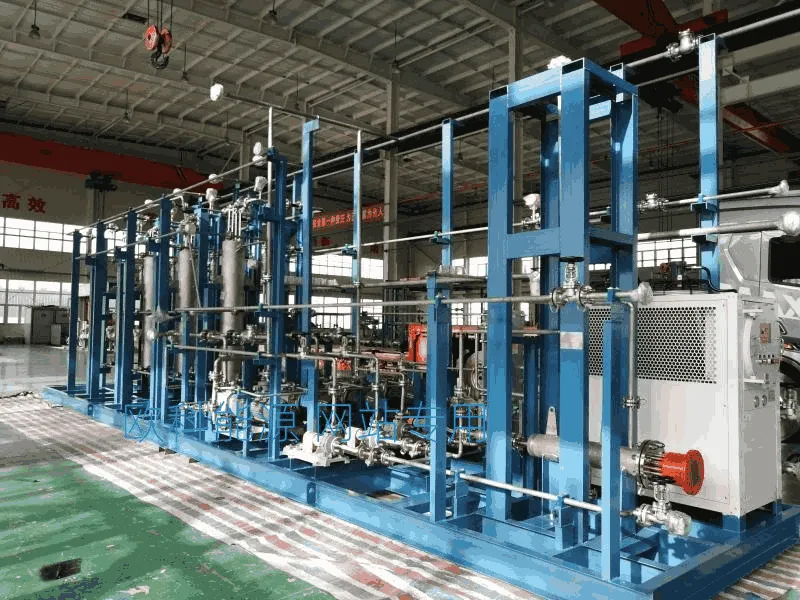
On paper, hydrogen blending natural gas is simple: put some hydrogen into a pipeline and the gas gets a little greener. In practice every percentage point changes what the gas is. Heating value and density both fall, and downstream equipment sees a different fuel. Below: what moves, what published testing shows, and what a blending skid must do about it. It sticks to figures from public sources and from our own documentation, and leaves out anything we can't back up.
Why heating value drops when you add hydrogen
Heating value is quoted per unit of gas volume, and hydrogen carries less energy per cubic metre than the natural gas it replaces. A US Department of Energy review of blending in gas networks says it directly: increasing the hydrogen blend fraction lowers both the calorific value and the density of the gas. The blend fraction in that work is the share of hydrogen by volume.
Testing in Ireland puts a number on it. In a programme that ran residential appliances on blends from 2% to 20% hydrogen, the gross calorific value fell by roughly 15% at the 20% blend compared with natural gas. So a burner fed the same volume of gas receives less heat.
That has a plain consequence. If your process needs a fixed amount of heat, either the volume flowing has to rise or the heating value has to be corrected. Which one you do is a control decision, and it's the reason heating value control sits next to blending in the same skid.
Wobbe index: can the burner still use it?
Heating value alone doesn't tell you whether a burner will accept a gas. The Wobbe index does more of that work. It's calculated from the calorific value and the relative density of the gas, and it's used to judge whether one fuel gas can stand in for another. The same DOE review lists it, together with the blend fraction and the calorific value, among its proposed metrics for gas quality.
The Irish programme checked it. In every blend up to 20% hydrogen, Wobbe index results stayed inside the national gas quality specification at entry points, which the authors treated as an important indicator for safe appliance performance. That's one network, one set of appliances and one specification, so it isn't a universal pass. What it does show is the method: measure the blend, compute the index, compare it with the limits where you operate.
Flow and pressure change too
Hydrogen's lower density has effects beyond the burner tip. The DOE review notes that energy flow is the product of volumetric flow and energy content, and that a higher hydrogen share means lower energy content and density, hence a faster volumetric flow for the same energy. It also warns that gas-fired generators typically have a minimum delivery pressure, which a lighter gas can end up violating.
Metering has the same problem: volume alone tells you little when each cubic metre carries different energy. The Irish programme evaluated metering accuracy too, alongside leak and safety testing, flue gas analysis and flame pictures. If you bill or control on energy, you need the composition as well as the flow.
Why the permitted share varies so much
There's no single global number for how much hydrogen a gas network may carry. The DOE review tabulates national limits that range from 0.1% in several places up to 10% at the top of the list, with a note that some are practical limits set by operators rather than formal rules. The Irish source adds that, depending on pipeline materials and engineering standards, existing polyethene distribution pipelines can take blends up to 20% hydrogen by volume without undue safety concerns, but thousands of connected devices in homes and businesses also have to be considered.
Our own stated position is a hydrogen blending ratio of 20% or less. We're named as main editor of China's Technical Specifications for Natural Gas Hydrogen Blending Stations. Our product documentation also describes a demonstration project for natural gas and hydrogen blended residential heating at a 20% ratio. Read 20% as a ceiling to confirm against the pipelines, appliances and rules in your own market, not as a default.
What a blending skid has to do
Put those effects together and the job of the skid is clear: hold the gas that leaves it inside the quality window no matter what the inputs do. Our calorific value control system is described this way:
- Heating value control accuracy of ±1%, improving to ±0.5% in key scenarios
- Free combination of natural gas, LPG, hydrogen, ammonia, nitrogen, air and industrial gases such as blast furnace and coke oven gas, with the mixing ratio adjustable from 0 to 100%
- An intelligent control platform that switches between gas sources automatically, feeds back in real time and adjusts the blending ratio dynamically as the source or the load changes
- Skid-mounted, modular construction for new projects and existing network retrofits
- Multiple gas concentration monitors and an emergency cut-off as safety redundancy
The same control idea works without hydrogen. In a 6000 Nm³/h LPG and air synthetic natural gas system in Southeast Asia, the two streams are mixed by dynamic flow-proportional control at 0.2 MPa, which keeps the calorific value and Wobbe index within natural gas standards so existing burners keep working. Swap the second stream for hydrogen and the logic is the same: measure, compare with the target, correct the ratio.
Our work on hydrogen mixing is also covered by patents, including a Chinese invention patent for a hydrogen energy gas blending device. Details are on the certifications and patents page.
Heating value control without hydrogen
Hydrogen is just one input. The system also blends LPG with air as a natural gas substitute in regions that depend on imported LNG, and it can mix low heating value industrial gases such as blast furnace and coke oven gas with pipeline natural gas or gaseous LNG and LPG. In both cases the task is the one described above: hold the outgoing heating value steady while the inputs wander. A steel plant project and a coastal LNG receiving station are among the applications listed on our product page.
Questions to settle before you specify a skid
- Which gases go into the blend, and how much does each drift over a day?
- Who sets the heating value or Wobbe index window the outgoing gas must meet, and what is it?
- Is the blend going into a new line, or into an existing network with unknown end users?
- What is the minimum delivery pressure for the largest consumers, such as generators?
- How will energy be measured for billing, by volume or by energy content?
If you can answer even half of those, send them through the contact page and we'll review the conditions with you.
FAQ
Does hydrogen blending change the heating value of natural gas?
Yes. Per unit volume hydrogen holds less energy, so the blend's calorific value drops as the hydrogen share grows. In Irish testing, a 20% hydrogen blend had about 15% lower gross calorific value than natural gas.
How much hydrogen can be blended into natural gas?
That depends on the country, the pipeline materials and the appliances connected to it. A DOE review lists national limits from 0.1% to 10%. Our recommended ratio is 20% or less, to be confirmed against local conditions.
What is the Wobbe index and why does it matter?
It's worked out from calorific value and relative density, and it shows whether one fuel gas can replace another in a burner. A blend has to stay inside the limits for the network it enters.
Can existing pipelines carry hydrogen blends?
Possibly. Depending on pipeline materials and engineering standards, polyethene distribution pipelines can accommodate blends up to 20% hydrogen by volume without undue safety concerns, but connected devices must also be assessed.